Cold Can, Warm Can, Change of Season: How Tokyo's Vending Machines Keep Time
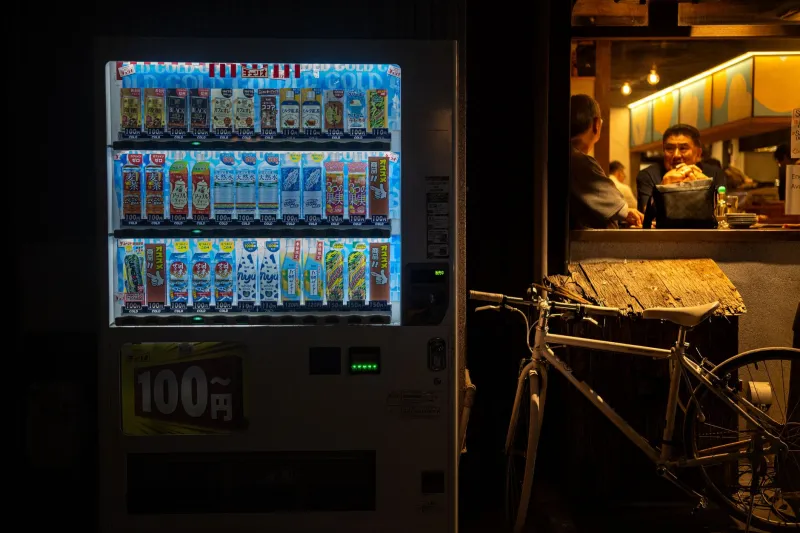
Somewhere between late October and early November, something shifts on a random corner in Nerima. The canned coffee that spent all summer glowing blue — signaling cold, signaling relief — starts glowing red. Warm. The machine didn't announce it. There was no press release, no seasonal campaign poster slapped across the front. It just happened, the way the air changed, the way the light went a little golden, the way people started walking a little faster with their hands in their pockets.
If you live in Tokyo long enough, you stop checking the weather app and start checking the vending machine.
The Unwritten Almanac
Ask any longtime Tokyo resident when they first really noticed the seasonal rotation, and they'll usually pause like you've asked them something weirdly personal. "I guess I just always knew," says Keiko, a 34-year-old graphic designer who's lived in Nerima-ku her whole life. "When the hot cocoa shows up, I know it's actually fall. Not calendar fall. Real fall."
That distinction — calendar time versus felt time — is kind of the whole thing. Japan has a deeply embedded cultural concept called kisetsukan, a sensitivity to seasonal change that shows up in food, clothing, home decor, and yes, what's sitting in the convenience store cooler or humming on the sidewalk outside your apartment. But the vending machine version of this is something different. It's more democratic. It's on every block. It doesn't require a reservation or a trip to a specialty shop.
The machines are everywhere — Japan has roughly one for every 23 people, a density that has no real equivalent in the US. In a country where you might walk past a dozen before you've finished your morning commute, the collective shift from cold to warm inventory reads almost like a neighborhood exhale.
The People Who Actually Decide
Here's what most people don't think about: someone has to make the call. The seasonal transitions don't happen by magic or algorithm alone — they happen because route workers and beverage distributors are paying close attention to a combination of temperature data, regional sell-through rates, and something a lot harder to quantify.
Takahiro has been running vending machine routes in west Tokyo for eleven years. He describes the transition period — that window in late October when a machine might carry both hot and cold versions of the same drink — as the most interesting part of his job. "You're reading the neighborhood," he says. "One block might flip earlier because it's older residents, more retired people who want something warm in the morning. Another block, near a school or a gym, stays cold longer."
That kind of hyperlocal calibration is something the big beverage companies — Suntory, Dydo, Asahi — actually build into their distribution models, even if they don't always advertise it that way. Regional field reps track not just weather but foot traffic patterns, demographic shifts, even local event schedules. A neighborhood with a big autumn festival might keep cold drinks stocked a week longer than the surrounding area because the crowds skew younger and active.
The result is that two machines three blocks apart can be in completely different seasons at the same time. To an outsider it looks random. To someone who knows the neighborhood, it's almost logical.
What Gets Stocked and Why It's Not Just About Taste
The seasonal drink calendar in Japan follows a rhythm that would feel familiar to anyone who's watched, say, Starbucks roll out its Pumpkin Spice season in the US — except it's woven into the infrastructure of daily life rather than a limited-time marketing event. Iced coffee and sports drinks dominate summer. Warm canned green tea and corn soup (yes, corn soup — it's exactly what it sounds like and it's genuinely great) take over by late fall. Hot lemon drinks and sweet potato lattes — a whole micro-genre of seasonal flavors — fill the gap between.
Beverage developers at the major companies spend months on the seasonal lineup. One product developer at a major Japanese beverage brand, who asked not to be named because she wasn't authorized to speak publicly, described the process as "part data science, part intuition, part tradition." She mentioned that certain flavors — roasted green tea, yuzu citrus, sweet red bean — are almost non-negotiable in their seasonal slots because consumers expect them. "If the hojicha latte doesn't appear by October, we hear about it," she said, laughing. "People feel it's missing."
That expectation is cultural memory in action. These aren't just flavors people enjoy — they're flavors that mean something, that have been paired with a particular slant of light or a particular kind of cold for long enough that the association has become instinctive.
The Neighborhood Rhythm You Can Actually Feel
What makes this specific to Tokyo neighborhoods — rather than just a nationwide beverage industry trend — is how the machines interact with local life. In a dense residential area like parts of Nerima or Koenji, the vending machine on your corner is a reference point. People notice when it changes. They comment on it.
"It's a little conversation starter," says Daisuke, who runs a small dry-cleaning shop near Nerima Station and has watched the same machine outside his storefront for eight years. "When the corn soup shows up, my customers mention it. 'Oh, it's that time.' It's like we're all checking in with the same clock."
That communal check-in is easy to miss if you're just passing through. It doesn't show up on any tourist map or food guide. But it's one of the ways Tokyo's neighborhoods maintain a shared sense of time — not the time on your phone, but the kind of time that's measured in temperature and taste and the small, reliable surprises of a machine that already knows what you need before you've decided you need it.
A City That Contradicts Itself, Beautifully
There's a version of Tokyo that gets exported to the rest of the world — hyper-digital, neon-lit, relentlessly modern. And that Tokyo is real. But so is the version where a retired man stops at a vending machine on his morning walk, picks up a warm can of milk tea, and marks the passage of another season with a single, unhurried sip.
The machine doesn't care about your schedule or your notifications. It just knows it's November. It's been warm since last week. You're welcome.
That's Tokyo, too — and honestly, it might be the more honest version of the two.