Nobody Told You the Rules, But Everyone Already Knows Them
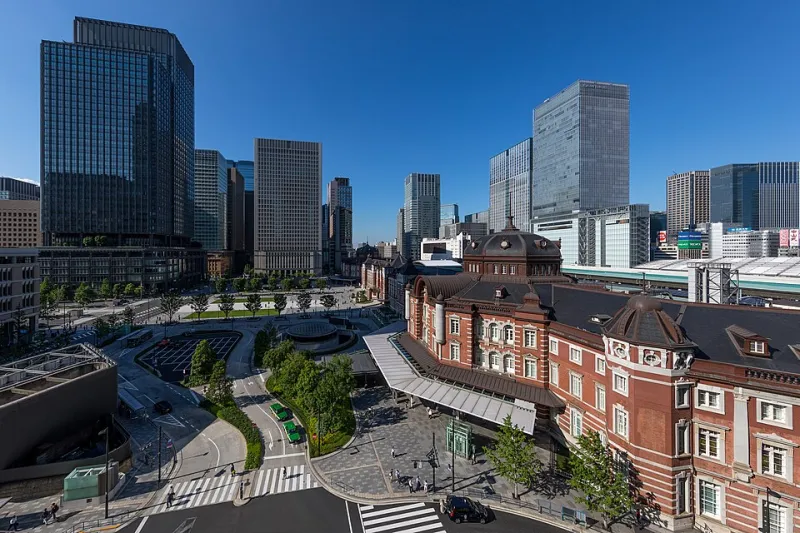
Photo: Basile Morin, CC BY-SA 4.0, via Wikimedia Commons
You step off the Yamanote Line at Shinjuku during rush hour and something strange happens. Thousands of people are moving in every direction at once, and yet nobody collides. Nobody shouts. Nobody even seems particularly stressed. It looks, from the outside, like a choreographed routine — except there was no rehearsal, no director, and definitely no instruction manual handed out at the gate.
Welcome to one of Tokyo's most underrated exports: the art of the unwritten rule.
The Escalator Is Not a Suggestion
Let's start with the one that trips up almost every first-time visitor. In most of Tokyo — and especially in Nerima, Shinjuku, and the commuter-heavy corridors of the city — escalator etiquette is basically law. Stand on the left, walk on the right. (Osaka flips this, which is its own whole conversation.) Nobody announces it. There's no placard. But the moment you plant yourself on the wrong side, you'll feel the collective awareness of everyone around you shift in your direction.
It's not hostile. It's more like a gentle atmospheric pressure. A soft recalibration of the social field.
What's wild is that this norm exists even though Tokyo's transit authority has actually asked people to stop walking on escalators altogether — for safety reasons. And yet the walking-on-the-right habit persists in many stations, because some rules are deeper than official policy. They live in the muscle memory of the city itself.
Eye Contact: The Complicated Calculus
In the US, making eye contact with a stranger on the subway is a loaded act. It can mean anything from "I see you" to "I'm about to start something." In Tokyo, the calculus is different — and arguably more nuanced.
On a crowded train, most riders will find a neutral focal point: a phone screen, the floor, the middle distance just above someone else's shoulder. This isn't rudeness. It's a kind of collective gift. In a space where personal space is physically impossible, people manufacture psychological space for each other by simply not looking.
But step into a neighborhood shotengai — one of those old-school covered shopping streets you find threading through residential areas like Nerima — and the rules shift again. Eye contact with a shop owner is expected, even welcomed. A nod, a small smile, a brief exchange about the weather or the season. The difference between "public transit stranger" and "neighborhood regular" is enormous in Tokyo, and the eyes are one of the main ways that distinction gets communicated.
The Queue as Social Contract
Americans queue. But Tokyo perfects the queue. At bus stops, you'll find painted marks on the pavement showing exactly where to stand. At train platforms, people line up in neat columns at the marked boarding doors — even during the controlled chaos of rush hour. Nobody cuts. Nobody drifts. And the moment the train arrives, the crowd parts naturally to let passengers off before anyone tries to get on.
This sounds small. It isn't. In a city of 14 million people, the queue is basically a load-bearing wall of social infrastructure. It's what allows density to function without constant friction. And unlike in some cities where queue-cutting is a calculated gamble, in Tokyo it's genuinely rare — because the norm is internalized, not enforced.
There's something almost philosophical about it. The queue says: your time matters as much as mine. It's radical equality expressed through the mundane act of standing in a line.
Reading the Room (and the Doorway)
One of the subtler codes involves thresholds — physical and social. Walk into a small ramen shop or a neighborhood izakaya and you'll notice the staff acknowledge you immediately, even if they're busy. That acknowledgment isn't just hospitality. It's a signal: you are seen, you are welcome, this space accepts you.
Conversely, there are spaces in Tokyo — certain members-only bars, tightly knit local establishments — where the vibe communicates the opposite just as clearly, without a single word being spoken. A slight pause in conversation. A glance that doesn't quite invite. The feeling of a room that isn't ready to expand. Outsiders sometimes misread this as unfriendliness. Regulars understand it as a different kind of honesty.
Learning to read these thresholds takes time. But once you can, you start to see the city differently — less as a series of spaces to navigate and more as a series of ongoing conversations you can choose to join or respectfully leave alone.
Volume as a Social Signal
Tokyo is not a quiet city. Trains rattle, pachinko parlors roar, festival drums echo off concrete. But there's a specific kind of quiet that's expected in certain contexts, and it's enforced socially rather than with signs.
Phone calls on trains are a good example. Technically there are reminder announcements, but the real enforcement is social. The moment someone takes a call in a quiet car, the air changes. Nobody says anything. But the awareness is palpable, and most people hang up quickly — not out of fear, but because they've absorbed the norm deeply enough to feel genuinely uncomfortable breaking it.
This is different from, say, a "quiet car" on an Amtrak train in the US, where the rule is explicit and compliance is hit-or-miss. In Tokyo, the expectation lives in the culture, not the policy. Which makes it both more powerful and more interesting.
What the Rules Are Actually About
Here's the thing that's easy to miss when you're cataloging all these unwritten codes: they're not about conformity for its own sake. They're about making collective life workable. In a city as dense as Tokyo — where your neighbor is three feet away and the train is packed body-to-body — social friction has real costs. The invisible rules are a distributed, community-developed technology for reducing that friction.
And they're not static. Walk through the shotengai in Nerima on a Saturday afternoon and you'll see older residents following one set of rhythms, younger folks navigating slightly different ones, tourists improvising entirely. The codes shift by neighborhood, by time of day, by the specific social texture of a place.
What's remarkable is that this all happens without a central authority dictating it. Nobody's in charge of Tokyo's invisible etiquette. It emerges from millions of daily interactions, adjusted and refined over decades.
For anyone coming from the US — where public behavior often feels more individualistic, more negotiated in real time — watching this system operate is quietly stunning. It suggests that community isn't something you build with big gestures. Sometimes it's built one escalator ride, one averted glance, one respectful queue at a time.