One Seat, One Person, No Apologies: How Tokyo Turned Being Alone Into an Art Form

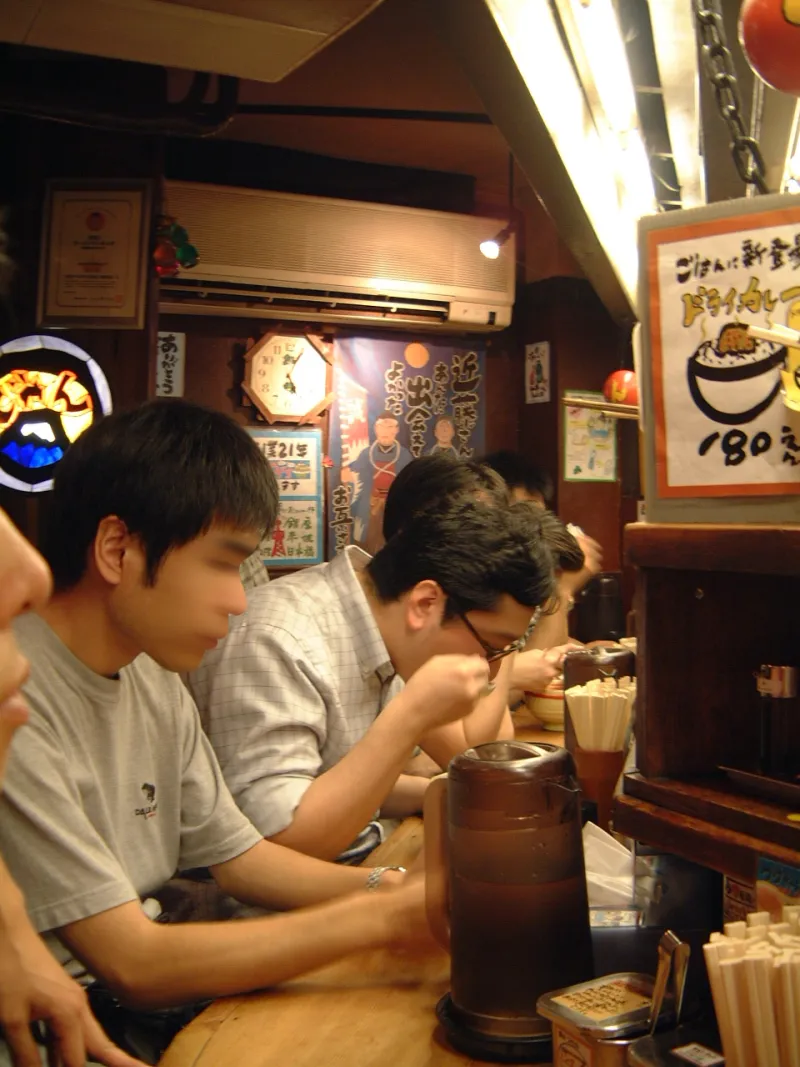
Photo: solo dining Japanese ramen counter single seat restaurant Tokyo, via p2.trrsf.com
There's a ramen shop in Nerima where every seat faces the wall. A narrow wooden partition separates each customer from the next. You order through a vending machine at the door, hand your ticket through a small curtained window, and eat your bowl in near-total silence. Nobody looks at you. Nobody judges you. Nobody asks if you're waiting for someone.
For a lot of Americans, that sounds like a punishment. For a growing number of Tokyoites — and honestly, for a growing number of Americans too — it sounds like a Tuesday night fantasy.
Tokyo has been quietly building an infrastructure for solitude for decades. And what started as a practical response to long work hours and cramped city living has evolved into something more philosophically interesting: a full-blown cultural embrace of being alone, on your own terms, without any of the social guilt that usually comes attached.
The Architecture of One
Solo dining in Tokyo isn't a niche — it's a design language. You see it in the ichiran-style ramen counters, where individual booths have become so iconic that the chain expanded internationally. You see it in the proliferation of hitori karaoke (solo karaoke) spots, where you can belt out two hours of Hikaru Utada without a single friend required. You see it in izakayas that now routinely offer counter seating specifically angled so that solo diners don't feel like they're sitting at the kids' table.
Business owners in neighborhoods like Koenji and Shimokitazawa — areas with dense young-adult populations — have been particularly tuned in to this shift. One café owner in Koenji, who asked to be referred to only as Mika-san, redesigned her floor plan three years ago to add more single-person window seats after noticing how many customers were quietly rearranging the furniture themselves.
"They weren't being antisocial," she said. "They wanted to be present in the space, but on their own terms. Once I gave them permission — by actually designing for it — they stayed longer and came back more."
That's a subtle but important distinction. Designing for solitude isn't designing against community. It's designing for a different entry point into it.
Loneliness vs. Aloneness — Tokyo Knows the Difference
Sociologists who study urban Japan have spent a lot of time trying to articulate something that Tokyoites seem to understand instinctively: loneliness and aloneness are not the same thing.
Loneliness is an absence — the feeling that connection should be there and isn't. Aloneness, at its best, is a choice. A practice, even.
Dr. Kenji Watanabe, a social anthropologist at a Tokyo university who studies urban isolation patterns, puts it this way: "Japan has a long cultural tradition of finding meaning in solitude — in literature, in aesthetics like wabi-sabi, in the meditative quality of certain crafts. What we're seeing now is that tradition meeting modern urban life and producing something new. People aren't withdrawing. They're curating."
Curating is the right word. Young Tokyoites — particularly those in their 20s and early 30s — talk about their solo time with the same intentionality that Americans might apply to a wellness routine. Going to a jazz bar alone. Eating at a counter seat with a book. Spending a Sunday afternoon at a neighborhood shotengai, browsing slowly without the pressure of keeping up with someone else's pace.
What This Did to Dating (And Didn't)
Here's where it gets complicated. Because if everyone is really good at being alone, what happens to relationships?
The short answer is: they change shape.
Dating culture in Tokyo — particularly among younger generations — has shifted toward what some researchers are calling low-stakes intimacy. Rather than the high-pressure, destination-heavy dates that dominate American dating app culture, many young Tokyoites describe first dates as almost incidental: meeting at a place you'd go alone anyway, with someone who might become part of your world or might not.
Yuki, 27, who works in graphic design in Nakameguro, described her last few dates as feeling more like "showing someone my city" than performing for them. "I took someone to my favorite standing soba place. We ate in like eight minutes. It was perfect. There was no pressure because neither of us needed the other person to make the experience good."
That confidence — the ability to show up somewhere solo and be completely fine — actually seems to make relationships healthier when they do form. When you're not desperately seeking company to fill a void, the company you do choose feels more genuine.
America Is Catching On, Slowly
Back in the US, solo dining is still navigating its awkward adolescence. Cities like New York, LA, and Chicago have seen a slow but real uptick in counter-seat-only restaurants, solo-friendly coffee shop designs, and even "singles tables" at bars — communal setups where solo visitors are gently directed toward each other without any forced interaction.
But there's still a residual cultural cringe around being seen alone in public. American dining culture, in particular, remains deeply couple- and group-oriented. A table for one at a nice restaurant still gets a look. A solo movie-goer still sometimes gets a pitying smile from the person scanning tickets.
Tokyo doesn't do that. And that small social grace — the simple act of not making someone feel bad for showing up alone — turns out to have enormous downstream effects on how comfortable people feel in public space, how often they leave their apartments, and how much incidental community gets built in the margins of solo outings.
The Neighborhood Is the Network
What's easy to miss in conversations about solo culture is how deeply neighborhood-rooted it is. The Tokyoite who eats alone at the ramen counter three nights a week isn't isolated from community — they're embedded in one. The shop owner knows their order. The regulars recognize their face. The rhythms of the block become familiar in a way that feels, paradoxically, more connected than a group dinner with near-strangers.
In Nerima, in Koenji, in Shimokitazawa — the neighborhoods that make Tokyo feel like a collection of villages rather than one enormous city — solo culture and community culture aren't opposites. They're the same thing wearing different clothes.
You come alone. You come back. You become a regular. And somewhere in that repetition, without any grand gesture or forced socializing, you become part of the place.
One seat. One person. No apologies. And somehow, over time, a little less alone.