3 AM, a Bowl of Ramen, and the Strange Peace You Didn't Know You Needed
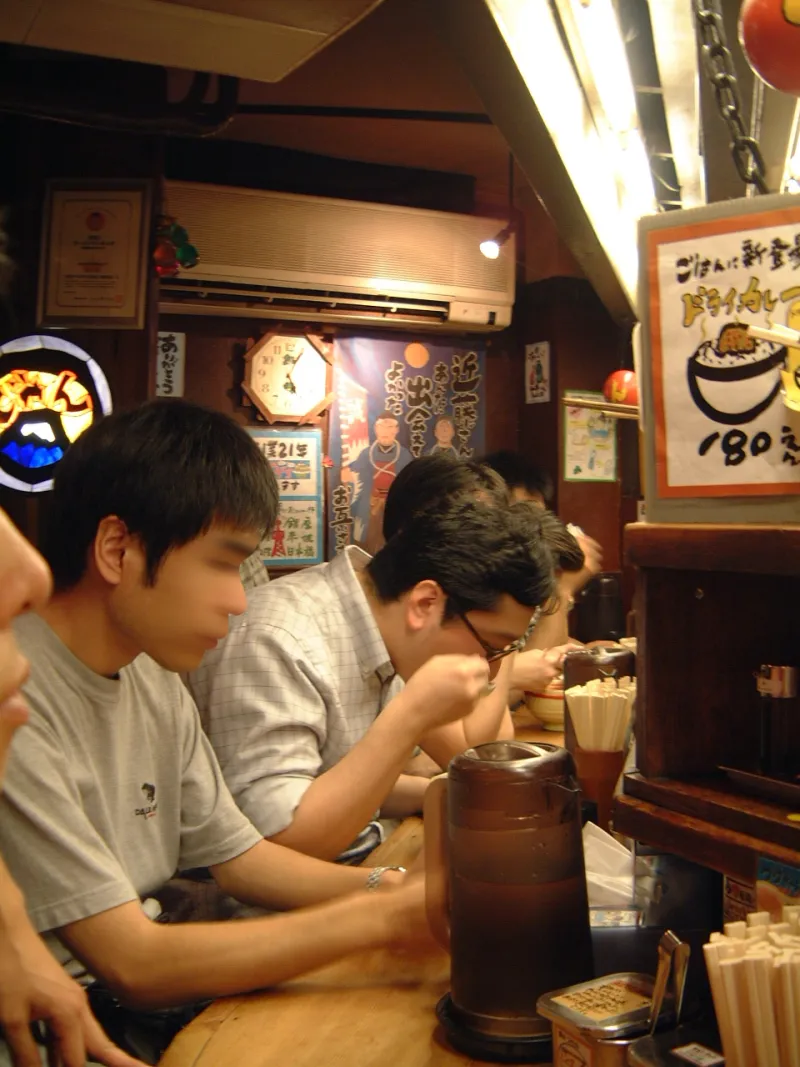
Photo: Marufish from Alor Setar, Malaysia, CC BY-SA 2.0, via Wikimedia Commons
There's a particular kind of quiet that settles over a Tokyo ramen shop at three in the morning. Not the quiet of emptiness — the shop might have four, five, six people hunched over steaming bowls — but the quiet of mutual agreement. Nobody's performing. Nobody's checking their phone. Everyone is just... eating.
If you've only ever thought of late-night food as a survival tactic — something you grab because you forgot to eat dinner or because a long shift finally ended — Tokyo's after-hours food culture is going to reframe that for you completely.
The Counter Is the Point
Walk into almost any late-night ramen spot in neighborhoods like Nerima, Shimokitazawa, or Koenji after midnight, and you'll notice something that feels almost theatrical in its simplicity: a long wooden counter, a handful of stools, and a chef working in full view. That's it. No cozy booths designed for lingering conversation. No ambient playlist curated to make you feel like you're in a coffee commercial. Just you, the counter, and the bowl in front of you.
This isn't an accident of interior design. The counter arrangement is intentional — it positions eating as the main event, not a backdrop to socializing or content creation. In a culture that prizes craft and presence, the layout of the room is essentially a gentle instruction: pay attention to what's in front of you.
For American diners raised on the idea that eating alone is somehow sad, or that a restaurant experience is measured by how Instagram-worthy the lighting is, this can feel genuinely disorienting at first. And then, somewhere around the third sip of broth, it starts to feel like relief.
The Chef Who Treats Broth Like Meditation
Spend enough time in Tokyo's late-night food scene and you start meeting a particular kind of cook — one who doesn't talk much but whose focus is almost meditative. These aren't celebrity chefs chasing Michelin stars or building personal brands. They're people who have, often over decades, narrowed their entire professional identity down to one thing: making this one dish as well as it can possibly be made, every single night, for whoever shows up.
In Nerima, there's a small tonkotsu counter that opens at 11 PM and closes whenever the broth runs out — sometimes 2 AM, sometimes 5. The owner, who has been running variations of this shop for over twenty years, describes his work not as cooking but as listening. Listening to the pork bones as they release their collagen. Listening to the noodles as they hit the water. The language sounds almost spiritual, but watching him work, it doesn't feel like an affectation. It feels like the most honest description of what he's actually doing.
This philosophy — treating a repeatable act as worthy of full attention every single time — is something that doesn't translate easily into American hustle culture. We tend to celebrate scale, efficiency, disruption. The idea that the highest form of mastery might be doing one small thing slowly and well, night after night, for a small number of people, is almost countercultural here.
Strangers at the Counter
One of the stranger and more beautiful things about Tokyo's late-night food ritual is what happens between people who don't know each other. There's an unspoken etiquette at the counter that's worth understanding before you stumble into it.
You don't introduce yourself. You don't ask what someone does for work. You might exchange a word or two about the food — a quiet acknowledgment that yes, the chashu is particularly good tonight — but you don't push past that unless the other person opens a door. What you share instead is something harder to name: a kind of companionship in the act of being present in the same place at the same hour, for the same reason.
For people navigating loneliness in a big city — and Tokyo, for all its density, can be profoundly isolating — this is its own form of community. Not the loud, performative kind that shows up in viral content about "third places," but something quieter and arguably more sustainable. You belong here because you showed up. That's enough.
What Wellness Culture Gets Wrong
America's wellness industry has spent years telling us that slowing down requires a retreat, a subscription, a carefully designed morning routine. Tokyo's late-night food culture suggests something more democratic: sometimes slowing down just means sitting at a counter at an unreasonable hour and committing, fully, to a bowl of noodles.
The ritual matters. The walk through the neighborhood at midnight. The noren curtain you push aside to enter. The moment you sit down and the chef nods without a word. The first taste of broth that's been simmering for eighteen hours. These aren't Instagram moments. They're just moments — and the fact that they're unremarkable is exactly what makes them restorative.
There's a concept in Japanese culture, ma, that refers to the meaningful pause — the space between things that gives them shape and significance. Tokyo's late-night ramen counter is, in a lot of ways, a physical manifestation of ma. It exists in the gap between the day that's ending and the one that hasn't started yet. And in that gap, if you let yourself settle into it, something genuinely nourishing happens.
How to Actually Experience This
If you're visiting Tokyo and want to tap into this rather than just walk past it, a few practical notes: don't go in a group larger than two. Don't open your laptop. Order what the chef seems proud of, not what looked good on a food blog. And when the bowl arrives, put your phone away and eat.
Neighborhoods like Nerima, Koenji, and Asagaya tend to have a higher concentration of the kind of low-key, chef-driven late-night spots that embody this philosophy — less tourist traffic, more regulars, more of that particular quiet. The walk to find them is part of the point.
You might feel a little self-conscious at first, eating alone at a counter in a foreign city at an hour when most sensible people are asleep. That feeling usually passes by the second bowl of broth. What replaces it is harder to describe but easier to recognize: the rare and underrated sensation of being exactly where you are, doing exactly one thing, and finding that to be completely enough.