Noodles at 2 AM and the Strangers Who Become Your People
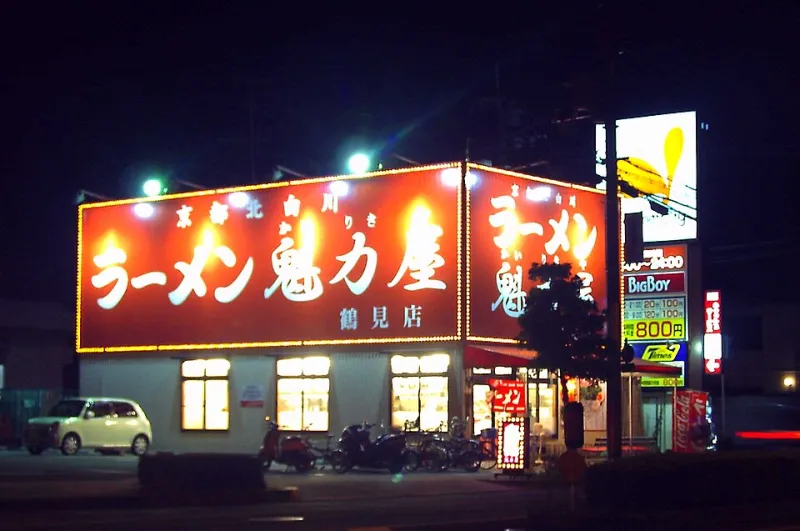
Photo: MASA (talk)(投稿者本人撮影), CC BY-SA 3.0, via Wikimedia Commons
There's a particular kind of loneliness that belongs to big cities. You can ride a packed subway car, elbow-to-elbow with a thousand people, and still feel completely invisible. Tokyo knows this feeling well — and yet, scattered across its neighborhoods, there are these small, glowing rooms where that loneliness tends to dissolve. They smell like pork bone broth. They seat maybe eight people. And they're open until three in the morning.
Welcome to the ramen-ya after dark.
The Counter as Equalizer
What's fascinating about Tokyo's late-night ramen scene isn't really the food — though the food is extraordinary. It's the seating arrangement. That long, narrow counter forces you into proximity with whoever else showed up hungry and sleepless tonight. On your left: a salaryman still in his wrinkled office shirt, tie loosened, scrolling through nothing on his phone. On your right: a young woman with paint-stained fingers who hasn't spoken to anyone since morning. Across the counter, the shop owner moves with the quiet efficiency of someone who has made ten thousand bowls and heard twice as many stories.
This setup, so ordinary in Tokyo, creates something genuinely rare: a space with no social hierarchy. You're all just people waiting for hot noodles. Nobody's more important than anyone else at a ramen counter at 2 AM.
Koji Matsumura, who has run a tiny shio ramen shop in Nerima for going on twenty-three years, puts it plainly. "When someone sits down here at this hour, they've already decided something. They decided they needed to be somewhere. This place is that somewhere for a lot of people."
He's not being sentimental. He's describing something structural. Ramen shops — especially the old-school ones without table seating — don't allow for the performance that most social spaces demand. You can't scroll your phone comfortably while eating ramen. You can't really avoid eye contact with the person making your food. The intimacy is almost architectural.
What People Actually Talk About
Ask longtime regulars what they discuss at their favorite ramen-ya and the answers range from the mundane to the profound, often in the same breath. Yuki, a 34-year-old graphic designer who frequents a miso shop near Ikebukuro, described a conversation she had with a retired schoolteacher who sat next to her on a rainy Tuesday night. "We talked for almost an hour. About regret, about whether it's too late to change careers, about his daughter who moved to Osaka. I don't even know his name. But I thought about that conversation for weeks."
This is the thing about ramen counters that doesn't translate easily to American dining culture. In the US, we tend to go out to eat with people — it's a social activity built around existing relationships. In Tokyo's late-night ramen world, the shop itself is the social relationship. You come alone, or you come with one friend, and the counter does the work of connecting you to whoever else wandered in.
Shop owners, whether they intend to or not, often become a kind of anchor for these interactions. Matsumura-san has watched couples have their first real argument at his counter. He's seen salarymen cry quietly into their bowls after bad news. He once stayed open an extra two hours because a group of university students were talking through something they clearly needed to talk through. "I just kept making tea," he said, shrugging like this was the most natural thing in the world.
Why It Works When Other Spaces Don't
There's a reason people open up at ramen counters in ways they might not at a bar, a café, or even a friend's dinner table. Part of it is the hour — there's a specific vulnerability that comes with being awake when the rest of the world is asleep. Part of it is the food itself, which is inherently comforting, warm, and unglamorous in the best possible way. You can't really be pretentious while eating ramen. The broth will find a way to humble you.
But a lot of it comes down to what sociologists might call a "third place" — a space that's neither home nor work, where the normal rules of social engagement get suspended. Tokyo has plenty of third places: the konbini, the sento, the neighborhood izakaya. But the late-night ramen counter has a specific energy because of who shows up. The insomniacs. The people coming off a long shift. The ones who had a fight at home and needed to walk somewhere. The artists who lose track of time. These are people who have, in some small way, opted out of the ordinary rhythm of the day — and that shared opting-out creates a kind of instant solidarity.
Nerima's Hidden Noodle Hours
Nerima, as a neighborhood, doesn't always make the shortlists of Tokyo's trendiest ramen destinations. That's precisely why it's worth paying attention to. The shops here aren't trying to be Instagram-worthy. The bowls are generous and unpretentious. The owners have often been doing this for decades, and their regulars have been coming for almost as long.
On a recent weeknight, the counter at one small tonkotsu shop in the neighborhood held a delivery driver still in his jacket, a woman who introduced herself as a nurse finishing a double shift, and a young man who said he was studying for exams but "needed a break from his apartment walls." Within twenty minutes, all three were deep in a conversation about whether Tokyo was getting harder to live in, whether rent was too high, whether the city was still worth it.
The nurse, somewhere around her second cup of tea, said something that stuck: "This is the only place I go where I don't have to explain myself."
That's probably the best description of a great ramen counter anyone could offer. No explanations required. Just show up, take a stool, and let the broth do its work.
Keep It in Mind Next Time
If you're visiting Tokyo — or if you live there and have somehow never ventured out past midnight for a bowl — consider this your nudge. Skip the famous spots with the lines around the block. Find something small, slightly worn around the edges, and open late. Sit at the counter. Don't rush.
You might just end up having the most honest conversation you've had in months with someone whose name you'll never catch. In Tokyo, that's not a missed connection. That's kind of the whole point.