Midnight Rails and Unspoken Rules: What Really Happens on Tokyo's Last Train
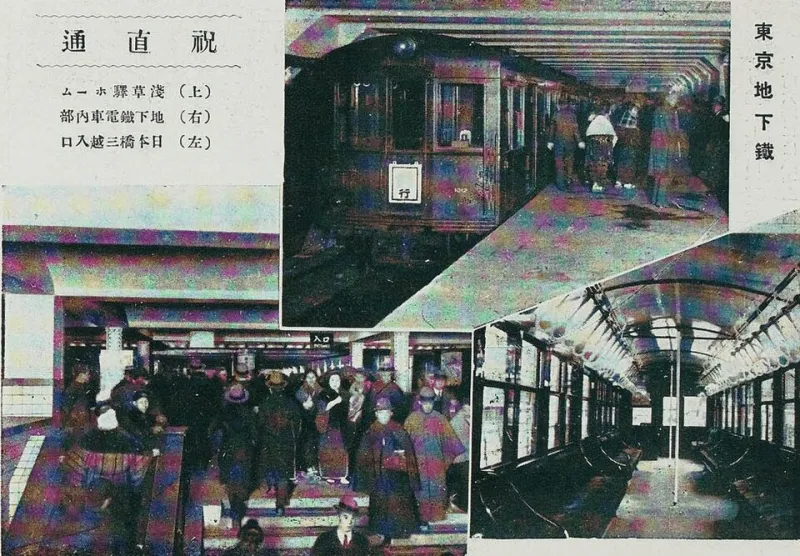
Photo: 東京高速鉄道 (Tokyo Rapid Railway), Public domain, via Wikimedia Commons
Somewhere around 11:45 PM on a weeknight, something shifts in Tokyo. The city doesn't go quiet exactly — it never really does — but the energy changes. Convenience store lighting feels a little harsher. The streets thin out. And at every major station, a specific kind of urgency ripples through the crowd: the last train is coming, and nobody wants to miss it.
For visitors, the last train is just logistics. For people who actually live here, it's something else entirely — a rolling social institution with its own rules, its own cast of regulars, and its own strange, unspoken intimacy.
The Car You Choose Says Everything
Step onto any late-night train in Tokyo and you'll notice something immediately: the distribution of passengers is not random. It looks chaotic, but it isn't.
Salarymen — ties loosened, briefcases balanced on knees — tend to cluster near the doors, ready to exit quickly or lean against the wall and doze without committing to a seat. Students, particularly those coming back from part-time shifts or late-night study sessions, gravitate toward the middle of the car, where it's easier to zone out with headphones without catching anyone's eye. Night-shift workers, nurses, convenience store employees, restaurant staff — they're often the quietest ones. They've been on their feet for hours. They've earned the window seat, and they know it.
Nobody announces these arrangements. Nobody enforces them. They just... exist. And if you sit in the wrong place — say, a clearly exhausted young woman in the spot that's been silently claimed by the same salaryman every Thursday for three years — the correction comes not through words but through the subtle language of body positioning, a slight shift, a glance held a half-second too long.
It's Tokyo's social grammar, written in posture.
Volume Has a Clock
During rush hour, the rules around noise are strict and widely understood: keep it down, keep your phone on silent, don't take calls. But the last train operates on a slightly different frequency.
A group of coworkers coming back from after-work drinks — what the Japanese call nomikai — is allowed a certain amount of volume. Not a lot. But enough. Laughter that's a few decibels too high gets a pass if it's clear the people are just happy and harmless. The unspoken logic seems to be: it's late, we're all tired, and sometimes tired people make noise. As long as it fades before the next station, nobody's really counting.
What's never tolerated, even at midnight, is the performative kind of loudness. The guy on the phone talking about his business deal. The tourist group narrating their evening to each other at full volume. That kind of noise reads as disrespectful — not just to the other passengers, but to the train itself. And yes, that sounds a little strange to American ears, but spend enough time in Tokyo and you start to understand it. The train has an atmosphere. You're expected to honor it.
The Regulars and the Recognition
Here's the part that surprises most outsiders: the last train has regulars. Not just people who happen to ride it often, but a genuine, recurring cast of characters who recognize each other across weeks and months without ever exchanging a single word.
There's a kind of peripheral intimacy that develops. You know the woman who always reads the same style of novel, cover bent back, completely absorbed. You know the older man who falls asleep between the second and third stop, every time, without fail. You know the teenage girl who mouths along to whatever's in her earbuds. You've never spoken. You never will. But you notice when they're not there, and something small and nameless shifts when they're back.
In neighborhoods like Nerima, where the Seibu and Toei lines carry people far out from the city center, these late-night communities have an especially particular flavor. The commutes are longer. The trains are less crowded. The regulars have more time to become familiar with each other's habits. It's a quieter, more suburban version of the same phenomenon — less electric than the Yamanote Line crowd, but no less real.
The Drunk Passenger Protocols
No honest account of the last train leaves this part out. Alcohol is a fact of late-night Tokyo transit. Salarymen who've been at a company dinner since seven. Friends who lost track of time at an izakaya in Shinjuku. The occasional solo drinker who simply needed the company of a bar stool for a while.
The etiquette around intoxicated passengers is surprisingly sophisticated. If someone is just sleepy-drunk — quiet, slumped, harmless — they're largely left alone. Occasionally, a fellow passenger will gently nudge them if their stop is coming up. It happens without drama, without making a scene. Just a tap on the shoulder, a gesture toward the door, and a nod. Done.
The harder cases — the ones who are loud, or unsteady, or taking up more than their share of space — are handled through a collective choreography of avoidance. People shift. Gaps open up. Nobody confronts, nobody escalates. The goal is always equilibrium, not justice.
It's a system that would frustrate a lot of Americans, who tend to prefer direct confrontation or at least the option of it. But in this context, it works. The train arrives at the final stop. Everyone gets off. The moment dissolves.
What the Last Train Actually Is
There's a word in Japanese — ma — that roughly translates to the meaningful pause between things, the space that gives structure its shape. The last train is a little like that. It exists in the gap between the city's public life and its private one, between the version of yourself you perform for the world and the one that slouches home at midnight with your shoes starting to hurt.
For Tokyo residents, it's not romantic, exactly. It's just real. It's the part of city life that doesn't make it into the travel brochures — the tired, slightly disheveled, quietly communal experience of getting yourself home when the day has finally run out of road.
And if you ever find yourself on one of those trains — maybe after a long evening in Ikebukuro, or cutting back through Nerima toward a friend's place — pay attention. Not to your phone. To the car. To the way people position themselves, the way the noise ebbs, the way a whole unspoken society arranges itself in real time around you.
Tokyo is always teaching. Even at 11:58 PM, two minutes before the last train leaves.